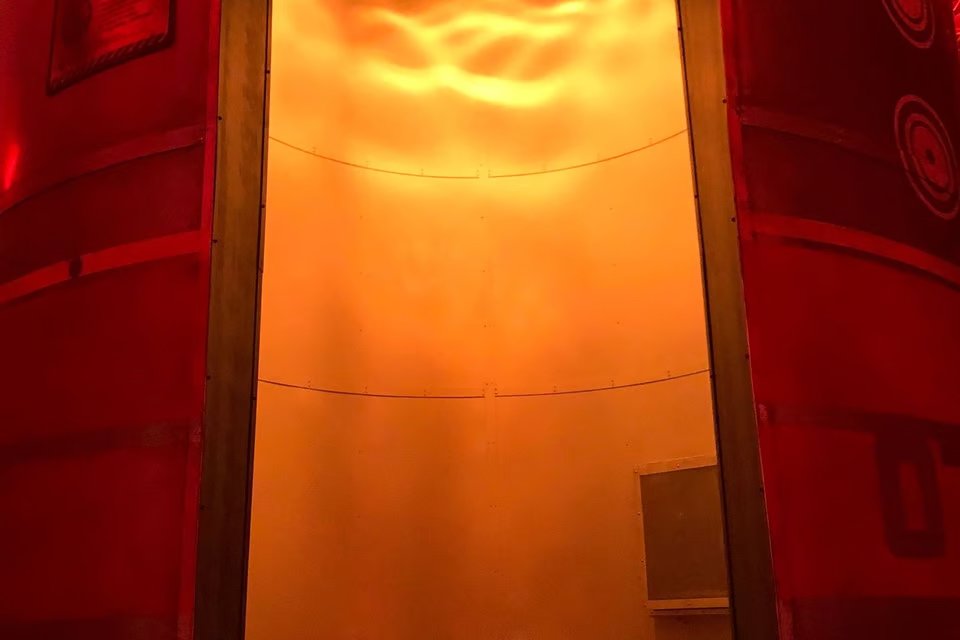
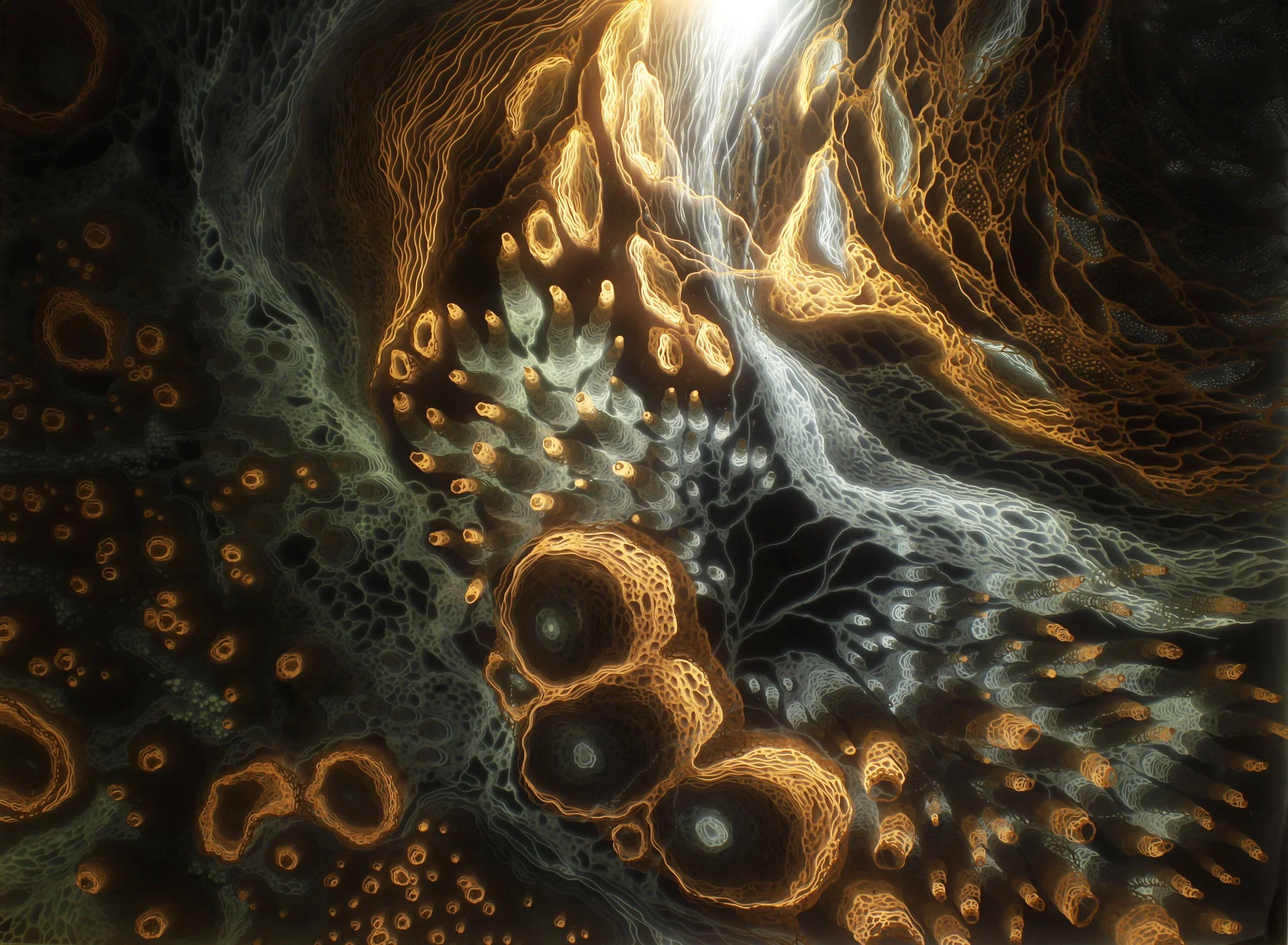
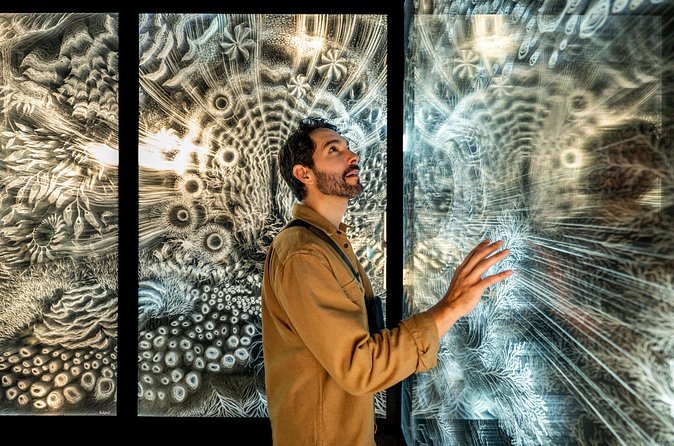
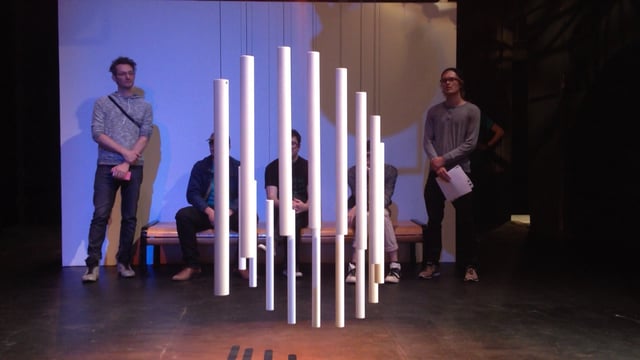
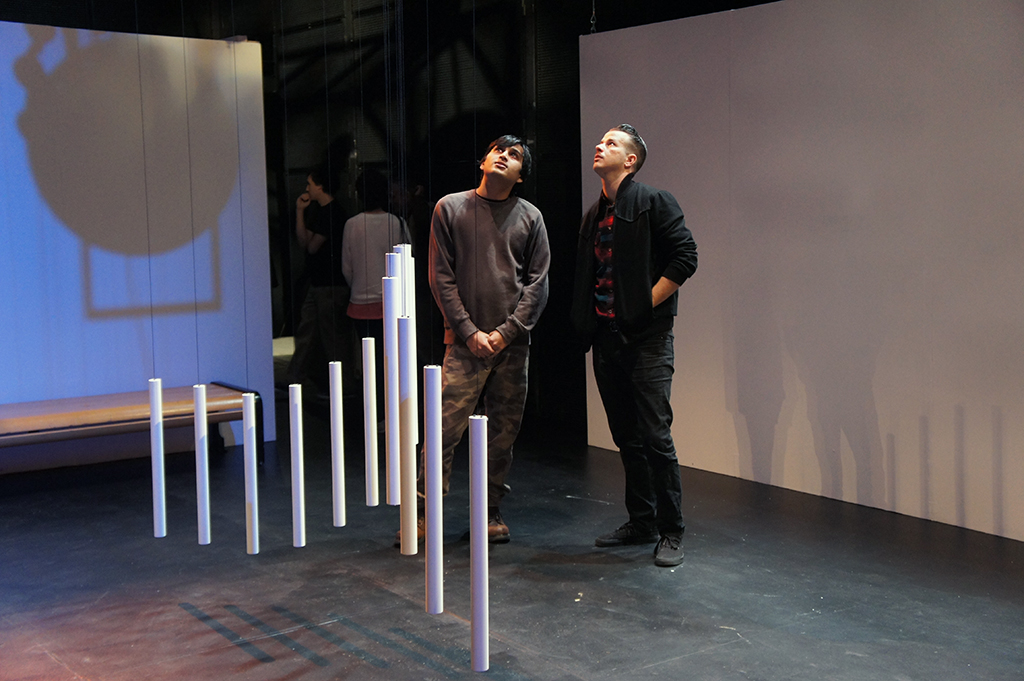
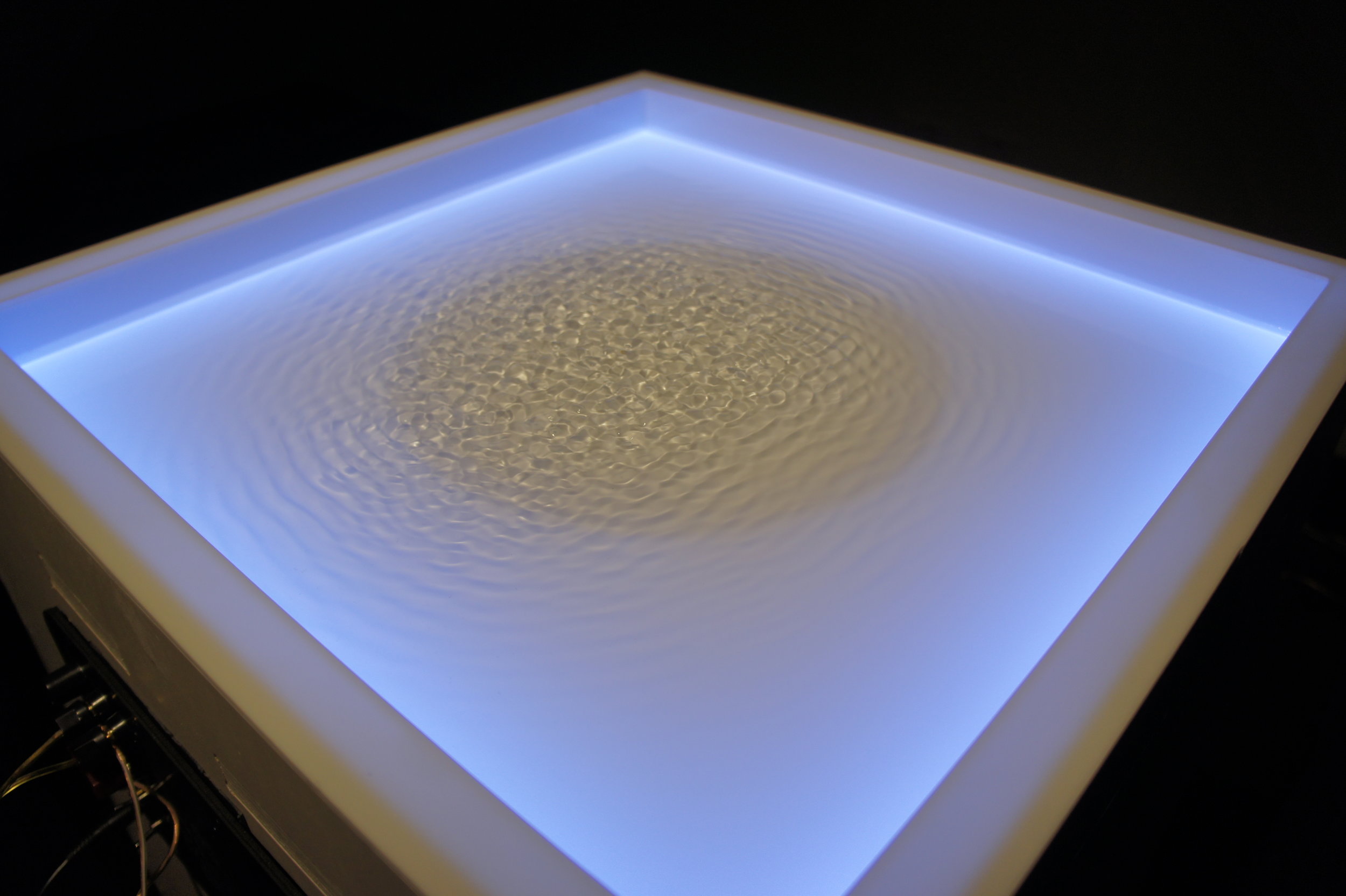
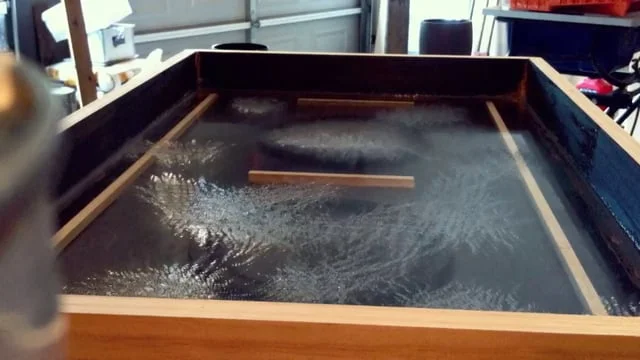
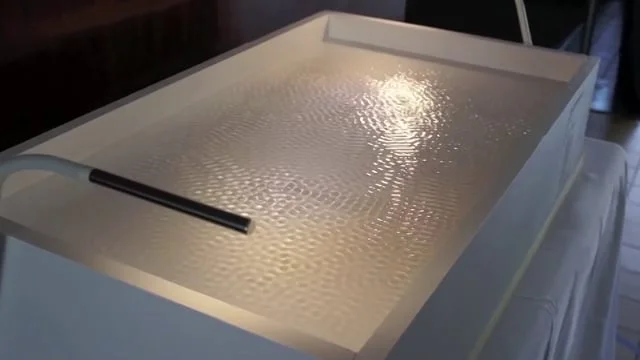
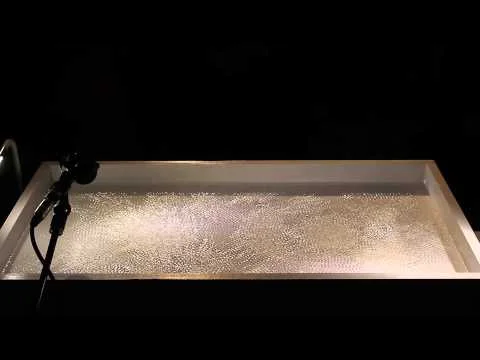
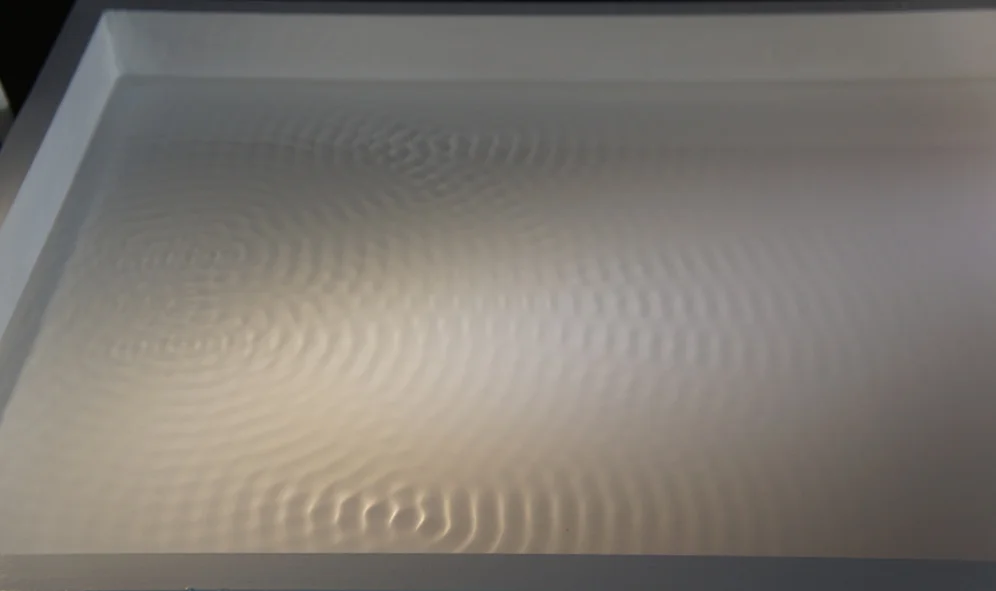
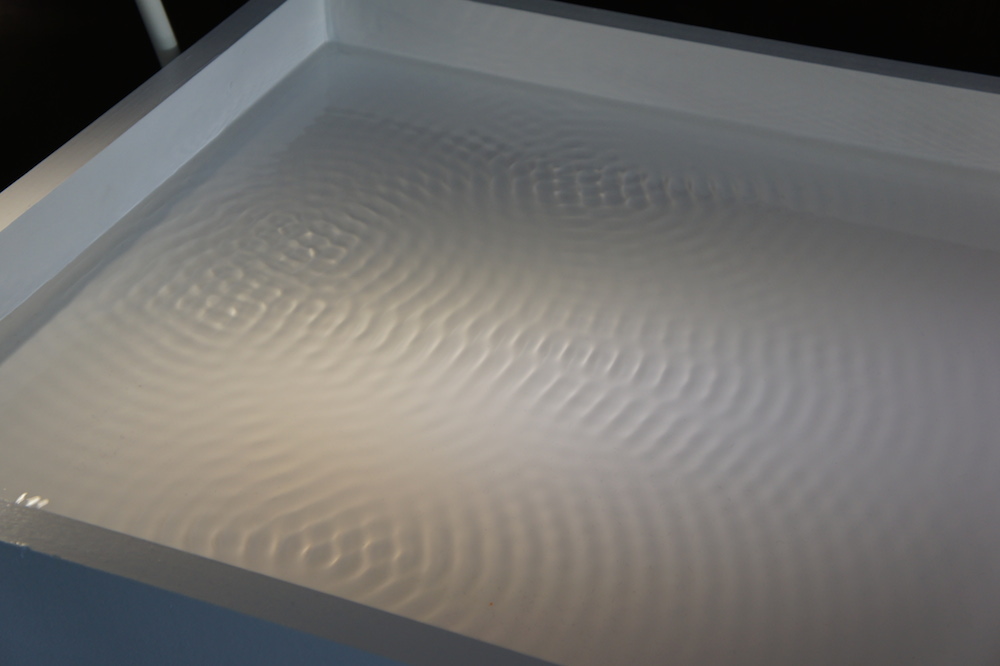
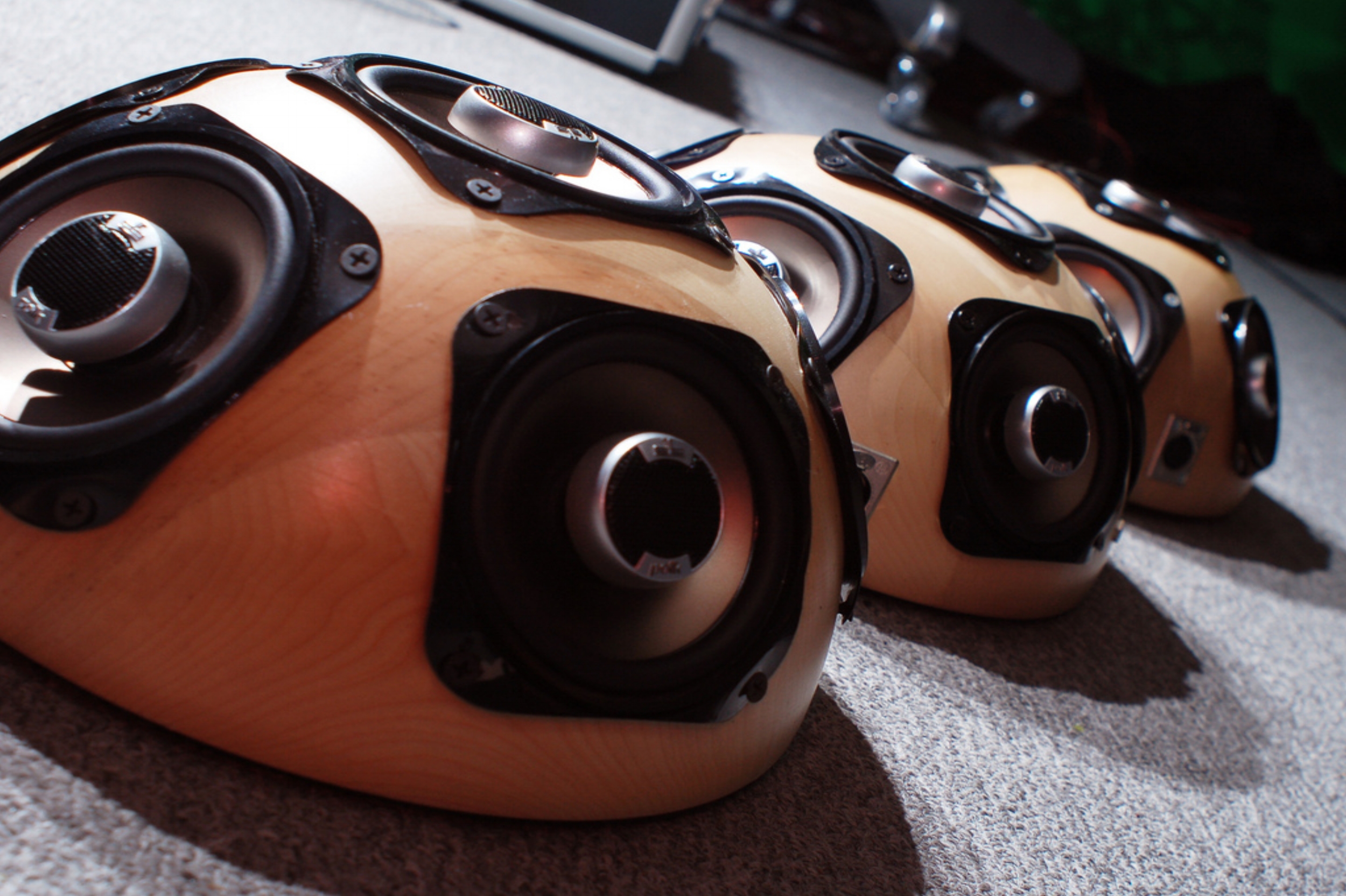
NODE is a reactive real-time audio/visual installation that centers around the concept of Cymatics (modal phenomena), which is the study of visible sound and vibration. Within the space, there are four large, identical cubes, each separated by two feet. At first, these cubes sit stagnant and appear to serve no real function. However, once a visitor approaches a cube, the cube slowly activates, lighting up and revealing a basin of water. At the same time, a low frequency tone starts to emanate from within the cube. As the tone gets louder, the liquid at the surface starts to react and complex, fractal-like patterns start to form on the surface. The sound from the cube is then re-enforced by surrounding satellite speakers that reproduce a higher equivalent fundamental frequency of the original tone.
Each cube functions as a discrete system, so as the visitor approaches a different cube, the first cube slowly fades out and the new cube activates, creating a different tone with a different complex pattern. However, the cubes are also interlinked. Therefore, if two people interact with two different cubes, both cubes will begin modulating one another, effecting the sonic and visual outcome. If all four cubes are activated, the patterns and sound generated becomes much more chaotic and unstable. It is possible, for example, to be in the space watching this event and not realize there is any reactive or interactive component to the piece until someone abandons a cube. At that point, the abandoned cube slowly begins to fade out and all of the remaining cubes that are still active become less chaotic; more clearly defined.
Essentially, NODE works like a large, interactive FM synthesizer, where each cube functions exactly like an “operator” in FM synthesis, with the ability to generate its own tone, as well as to modulate another. This “morphing” that occurs when more than one person is viewing the piece is a key element in terms of the interactive component of NODE.
The ability for someone else to impact what you, as a viewer, are experiencing gives the piece a social component. Since the patterns that occur in the liquid are directly related to the sound being generated, the viewer gets a window into what the sound actually looks like. NODE provides the viewer with unique insight into the invisible world of mechanical waves as they exist in nature. The more complexity within the sound, the more complex the pattern.
The purpose of this installation is to show clear visible relationships between acoustic signals and modal phenomena, allowing visitors to experience what is normally beyond their scope of vision - in this case, the beauty and complexity of mechanical waves that exist throughout nature. More specifically, we typically visualize sound, whether in terms of time (oscilloscope) or frequency (spectral/fft), by way of mathematical approximation. Because modal phenomena exists in nature, it provides an actual view into what sound looks like when traveling through a physical medium.
NODE was designed as an attempt to create a piece that is indicative of a sort of chaotic order within a controlled and inherently deterministic system; one that is both complex, yet repeatable. In a way, the visitors become a larger part of that system. Much like in a society, the more people interacting with the piece, the more complex and chaotic the installation becomes. NODE was additionally designed to give groups of people different experiences. For instance, if only one person interacts with the installation, the complexity of the patterns and sound that emerge is limited to just a single event. This is conceptually symbolic of people’s ability to be alone with their thoughts. One cube creates a hypnotic state represented by a single sine wave, creating a calm and repeating pattern. However, if a second person interacts with the installation, both the sound and the patterns that occur become more complex, making it more difficult to see the visitor’s individual voice within the piece. This continues until both the patterns and the sound hit a saturation point and the individual becomes lost in the noise and complexity of the system. By learning how the system functions, the visitors might interact in such a way as to control the outcome, creating a large harmonically powerful event. When considering NODE and the nature of physics, there are many obvious parallels between these complex, repeatable events and how human beings interact in society, existing within the framework of a social order, and how we as a society tend to follow patterns within a social construct. This concept is the basis for the interactive elements of NODE. In a strictly utilitarian sense, NODE is a large, fully functional synthesizer, where the visitor becomes the performer. The performance itself - a form of social interaction.
NODE was designed and fabricated by Meason Wiley and Amber Lepley in the Spring of 2015 at California Institute of the Arts.
NODE was installed in the WaveCave Gallery at CalArts in May of 2015. NODE was later installed at Louisiana State University for the NIME Conference (2015).